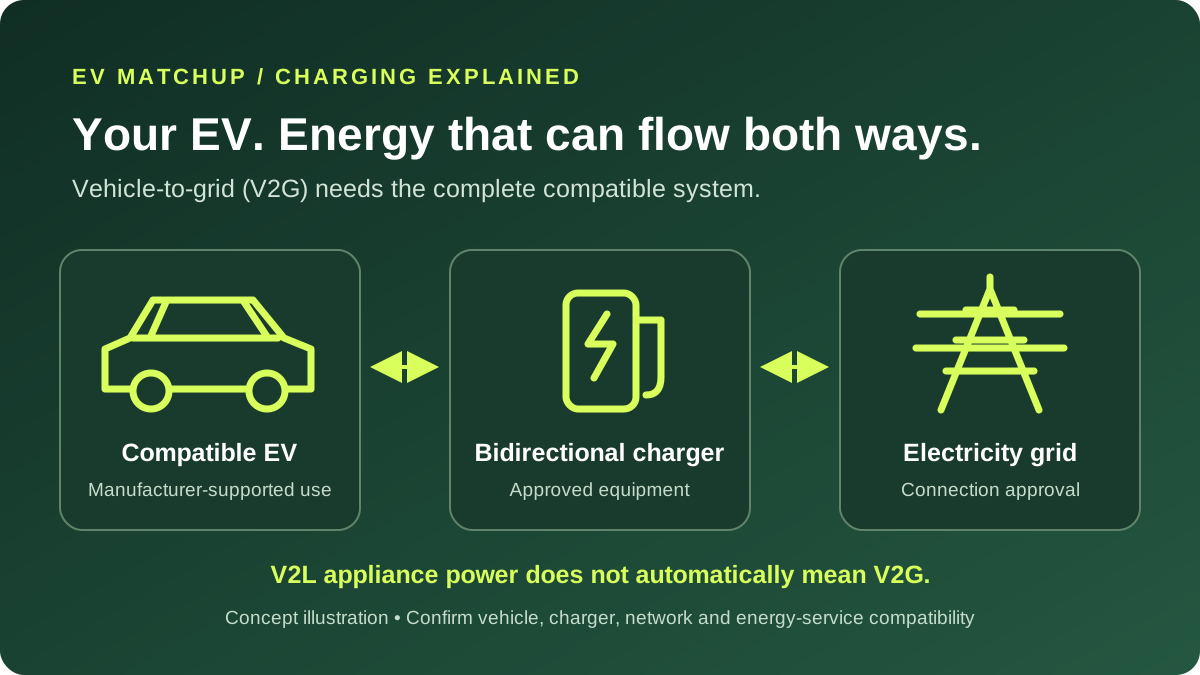
Vehicle-to-grid (V2G) lets a compatible EV send stored electricity back to the grid. It is already being deployed in Australian projects, but it is not a standard feature you can use with any EV and ordinary wallbox. Vehicle support, equipment, network approval and an energy service all matter.
Your car may spend hours parked with energy sitting in its battery. Two-way charging offers a way to use some of that energy elsewhere while keeping enough for driving. Australia's latest fleet project is about making that work in everyday operations.
What was announced on 21 October?
The Australian Renewable Energy Agency (ARENA) announced $4 million in funding to JET Charge for Realising Electric Vehicle-to-Grid Services 2, or REVS2. It plans to deploy up to 130 EVs and bidirectional chargers across the ACT Government fleet.
ARENA describes it as Australia's largest commercial V2G deployment. Building on the earlier REVS trial, the project will test how a working fleet can support the grid and receive value for doing so while remaining available for transport. This is a project announcement, not evidence that every household can buy the same setup or earn a particular income. Read ARENA's announcement.
V2G, V2H and V2L: three different uses
| Feature | Where the energy goes | What to check |
|---|---|---|
| V2G: vehicle-to-grid | From the EV battery back to the electricity network. | Supported vehicle and charger, connection approval and export arrangements. |
| V2H: vehicle-to-home | Into the home's electrical system to supply household loads. | Supported installation; blackout backup must be confirmed separately. |
| V2L: vehicle-to-load | Directly to selected appliances through a vehicle socket or approved adaptor. | Manufacturer power limits. V2L alone does not establish V2G support. |
V2X, or vehicle-to-everything, is the umbrella term. A model offering one function does not necessarily offer the others. The Australian Government's V2X guide explains the differences and the need for manufacturer confirmation.
Can households use it already?
Residential deployments exist too. In a release dated 1 November 2025, ARENA reported the first residential installation in an Amber Electric project involving 50 V2G-capable chargers. That is earlier project evidence, not a claim that all 50 are available to new customers today.
Ask for a supported Australian setup for your vehicle and address. An overseas demonstration, matching plug or promised software update does not establish local export capability. Ausgrid requires a connection application for each proposed V2G premises and approved equipment under its guidelines. Energex also requires approval before installation. Check your own distributor: these examples are not a single national approval.
Six questions before buying a setup
- Does the exact vehicle support it? Confirm Australian model year, grade, software and manufacturer-supported V2G operation.
- Which charger works with it? Request the exact supported vehicle-and-charger pairing. A conventional one-way wallbox cannot simply export energy from the car.
- Can it connect at your property? Have an installer check switchboard, metering, supply, solar and battery equipment, and network export limits.
- Who manages and pays for exports? Confirm retailer or aggregator eligibility, tariffs, fees and control settings. Export capability does not guarantee a payment.
- How is the battery covered? Read the warranty and approved-use conditions. Extra cycling can affect wear; outcomes differ between batteries and operating conditions.
- Will the car be ready when needed? Check departure-time settings, minimum battery reserve, manual overrides and what happens when you are away.
JET Charge's V2G resource outlines equipment, connection and service requirements. Confirm current availability for the exact Australian vehicle rather than relying on a general brand-level list.
Will it save money or replace a home battery?
Potential benefits include using stored solar later and receiving payment for eligible exports. The financial result depends on installed equipment cost, electricity bought to recharge, export payments, fees, energy losses and how often the car is plugged in. Obtain an itemised quote and compare ongoing service terms. There is no universal annual saving or guaranteed payback period.
Our view: start with when the car is actually home. A car away during sunny hours may have less opportunity to absorb rooftop solar. A household needing backup while the car is away may still value stationary storage. Assess the energy setup alongside your transport needs rather than counting potential income as a guaranteed discount on the car.
What should buyers do now?
Treat V2G as a feature to investigate, not something every new EV already delivers. Confirm the complete arrangement with the manufacturer, installer, distributor and energy provider before spending money. Fast DC charging and V2L capability do not prove V2G compatibility.
REVS2 is worth watching because it tests a larger fleet's practical and commercial operation. It does not remove the need to check your particular car, property and service.
Useful next reads
- Home charging costs, batteries and warranties
- Installing a charger in an apartment or rental
- Owning an EV without a home charger
Sources and methodology
EV Matchup prioritises Australian manufacturer pages and government resources. Editorial recommendations are our own.
- ARENA — REVS2 announcement, 21 October 2026
- ARENA — residential Amber Electric project, release dated 1 November 2025
- Australian Government — V2X compatibility and battery considerations
- JET Charge — equipment, supported vehicles and service requirements
- Ausgrid — installation guidelines and connection applications
- Energex — bidirectional connections, costs and backup considerations